



OUR
SERVICES

REGULATORY

SERVICES

Comprehensive Compliance: Stay ahead of regulatory changes with our in-depth knowledge, minimizing the risk of delays and rejections in the approval process
  • Import permit licenses
  • Product licenses: Food supplements, cosmetics, drugs, and medical devices

Thai FDA Registration

ENSURE SEAMLESS MARKET ENTRY

Thai FDA Registration

ENSURE SEAMLESS MARKET ENTRY

FOOD SUPPLEMENTS REGISTRATION

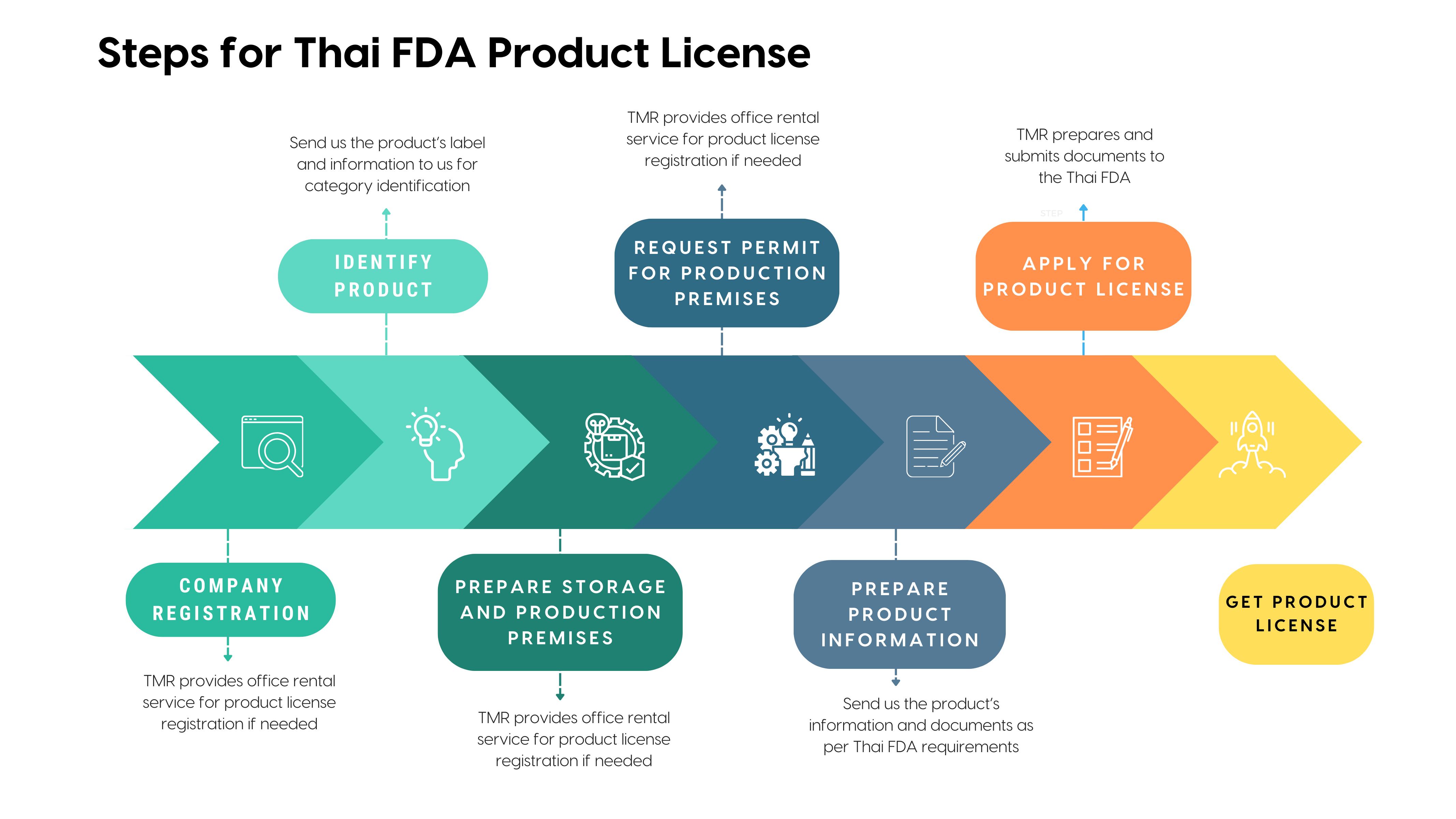
Steps to Follow for Food supplements License Application

Step 1: Premises

Preparing the premises for importing or ordering food supplements into the Kingdom of Thailand can be divided into 2 parts:

1. Food supplements Importation Premises (Office)

2. Food supplements Storage Premises

NOTE: Navigating FDA product license registration without a local company? We provide comprehensive support for seamless license submission, ensuring compliance every step of the way. Connect with us for hasslefree assistance in meeting regulatory requirements, allowing you to handle the importation or ordering of Food supplements into the Kingdom of Thailand seamlessly

Step 2: Product Categorization

Categorizing the products before submitting the registration application can help ensure accurate submission and reduce the processing time.

Step 3: Preparation of supporting documents for product registration & List of documents for application submission for Food supplements importation premises
List of documents for submitting an application for Food supplements importation premises (basic):

1. Application form

2. Copy of the company's certification

3. Copy of the company's registration

4. Copy of the house registration of the production location

5. Copy of the house registration and ID card of the directors

6. Photographs of the import location and equipment

7. Location map and coordinates of the production location

8. Various certifications

9. Medical certification

List of documents for submitting a product registration application (basic): **depends on the type of Food supplement product

1. Name and formula of 100% production

2. Production procedure

3. Consumption method/ consumption quantity

4. Product label

5. Test results (if any)

6. Specifications

7. Certificate of analysis

8. Details of packaging

9. Storage method / storage life

10. Certificate of production / import location

11. Quality specifications for important components

12. Documents certifying quality standards (ISO 22000, HACCP and FSSC)

13. Application form and other documents as required by the food group.

COSMETIC REGISTRATION

Steps to Follow for Cosmetic License Application

Step 1: Premises

Preparing the premises for importing or ordering cosmetic into the Kingdom of Thailand can be divided into 2 parts:

1. Cosmetic Importation Premises (Office)

2. Cosmetic Storage Premise

NOTE: Navigating FDA product license registration without a local company? We provide comprehensive support for seamless license submission, ensuring compliance every step of the way. Connect with us for hasslefree assistance in meeting regulatory requirements, allowing you to handle the importation or ordering of cosmetic into the Kingdom of Thailand seamlessly

Step 2: Product Categorization

The process of applying for product license for each type of product may vary, and it must be submitted correctly according to the type of product.

Step 3: Preparation of supporting documents for product registration & List of documents for application submission for cosmetic importation premises
List of documents for submitting an application for a cosmetic importation premises (basic):

1. Application form

2. Copy of the company's certification

3. Copy of the company's registration

4. Copy of the house registration of the production location

5. Copy of the house registration and ID card of the directors

6. Photographs of the import location and equipment

7. Location map and coordinates of the production location

8. Various certifications

9. Medical certification

List of documents for submitting a product registration application (basic): **depends on the risk level of the cosmetic product

1. Name and formula of 100% production

2. Production procedure

3. Consumption method/ consumption quantity

4. Product label

5. Test results (if any)

6. Specifications

7. Instruction for use

8. Storage life

9. Application documents and other documents as specified by the Cosmetic Control Group

MEDICAL DEVICE REGISTRATION

Steps to Follow for Medical Device License Application

Step 1: Premises

Preparing the premises for importing or ordering medical device into the Kingdom of Thailand can be divided into 2 parts:

1. Medical device Importation Premises (Office)

2. Medical device Storage Premises

NOTE: Navigating FDA product license registration without a local company? We provide comprehensive support for seamless license submission, ensuring compliance every step of the way. Connect with us for hasslefree assistance in meeting regulatory requirements, allowing you to handle the importation or ordering of medical device into the Kingdom of Thailand seamlessly

Step 2: Product Categorization

The process of applying for product license for each type of product may vary, and it must be submitted correctly according to the type of product.

Step 3: Preparation of supporting documents for product registration & List of documents for application submission for Medical device importation premises
List of documents for submitting an application for a Medical device importation premises (basic):

1. Application form

2. Copy of the company's certification

3. Copy of the company's registration

4. Copy of the house registration of the production location

5. Copy of the house registration and ID card of the directors

6. Photographs of the import location and equipment

7. Location map and coordinates of the production location

8. Various certifications

9. Medical certification

List of documents for submitting a product registration application (basic): **depends on the risk level of the medical device product

1. Instruction for use

2. Product label

3. User manual

4. Documents certifying quality standards (ISO 13485)

5. Production and Material Flow chart

6. Application documents and other documents as specified by the Medical Device Control Division

7. Certificate of Free Sales (CFS)

DRUG REGISTRATION

Steps to Follow for Drug License Application

Step 1: Premises

Preparing the premises for importing or ordering drug into the Kingdom of Thailand can be divided into 2 parts:

1. Drug Importation Premises (Office)

2. Drug device Storage Premises

NOTE: Navigating FDA product license registration without a local company? We provide comprehensive support for seamless license submission, ensuring compliance every step of the way. Connect with us for hasslefree assistance in meeting regulatory requirements, allowing you to handle the importation or ordering of drug into the Kingdom of Thailand seamlessly

Step 2: Product Categorization

The process of applying for product license for each type of product may vary, and it must be submitted correctly according to the type of product.

Step 3: Preparation of supporting documents for product registration & List of documents for application submission for drug importation premises
List of documents for submitting an application for a drug importation premises (basic):

1. Application form

2. Copy of the company's certification

3. Copy of the company's registration

4. Copy of the house registration of the production location

5. Copy of the house registration and ID card of the directors

6. Photographs of the import location and equipment

7. Location map and coordinates of the production location

8. Various certifications

9. Medical certification

List of documents for submitting a product registration application (basic):

1. Primary & Secondary Packaging Labels

2. Drug Master File (DMF)

3. Thai & English Product Labeling

4. Sample Product for Analysis purpose (If any)

5. Good Manufacturing Practice (GMP) Certificate

6. Factory Process Assessment Reports

7. Rectification Plan

8. Site Master File

9. Quality Manual

10. Certificate of Pharmaceutical Product (CPP)

11. Application documents and other documents as specified by the Thai FDA

TRADEMARK

REGISTRATION

Protect Your Brand: Safeguard your intellectual property with our comprehensive trademark services
Risk Mitigation: Our team conducts thorough trademark searches, minimizing the risk of infringement issues and potential legal disputes down the line
Understanding Trademarks and the Registration Process in Thailand
A trademark is a distinctive symbol used to represent products or services, distinguishing them from similar offerings by others. Take the iconic NIKE trademark, for instance, which sets apart their shoes and sports equipment from those of other brands.

For business owners or product creators, it is advisable to design a unique sign and register it as a trademark with the Department of Intellectual Property. This not only enhances business operations but also provides legal advantages

Business Benefits of Trademarks:

Brand Recognition:
Trademarks help consumers identify and associate your products with your brand
Credibility Boost:
Trademarks can be used as collateral with various financial institutions.
Business Expansion:
Trademarks facilitate business expansion, such as through franchising.

Legal Benefits of Trademarks:

Trademarks are protected under the Trademark Act B.E. 2534, amended by the Trademark Act (No. 2) B.E. 2000 and the Trademark Act (No. 3) B.E. 2016. Once registered with the Department of Intellectual Property, trademarks are protected for 10 years (extendable), preventing unauthorized use by others. Legal actions can be taken against infringement, leading to compensation for the trademark owner.

Conditions for Obtaining Trademark Registration:

1.The mark must have specific identifying characteristics, differentiating it from others.
2.It must not be prohibited by law, such as royal emblems, national emblems, or symbols against public order.
3.It should not be identical or similar to already registered trademarks

Documents and Evidence for Trademark Registration:

1.Original application (Form A. 01).
2.Image of the trademark (not exceeding 5×5 cm, file size below 500KB). *Please note that images that exceed the size limit will be subject to an additional 200 baht fee per centimeter.
3.Identification card of the trademark owner
4.Letter explaining the origin and meaning of the trademark.
5.Confirmation letter from a foreign government agency owning the trademark.

Additional Requirements for Individuals and Juristic Persons:

  • Individuals: Submit a copy of your ID card or passport, signed correctly.
  • Juristic Persons: Provide a copy of the juristic person certificate issued within the last 6 months, along with a signed copy.
  • Power of Attorney: If applicable, include a copy of the power of attorney and the representative's ID card, both signed correctly.

Trademark Registration Process:

1.Check the uniqueness of your trademark against existing registrations.
2.Prepare supporting documents for the registration application.
3.Register documents, submit the application, and pay the necessary fee.
4.Wait for official consideration. Address any additional questions from officers if required.
5.If all documents are correct and the mark is unique, approval is typically granted within 1 year from the application date.
Ensure the protection and uniqueness of your brand by navigating the trademark registration process diligently.

CUSTOMS

CLEARANCE

Expedite your supply chain with our customs clearance services, ensuring timely and hassle-free movement of goods from customs clearance
Navigate the intricacies of customs regulations effortlessly, reducing the risk of fines and delays associated with noncompliance
UnderstandingCustom Clearance in Thailand for Importing and Exporting Goods
Custom clearance, also known as customs procedures, is the process of obtaining permission to import or export foreign items or goods from a country. This involves submitting necessary documents to customs authorities in both the country of origin and the destination country. The success of this process determines whether the items can be legally exported or imported. Business owners looking to engage in international trade often opt for shipping company services due to their expertise in custom clearance.

Types of Custom Clearance:

Import Custom Clearance:
Import custom clearance involves the process of bringing goods into the country. It requires obtaining permission from the customs department of the destination country, preparing necessary import documents, and complying with import taxes and regulations.
Export Custom Clearance:
Export custom clearance is the process of exporting goods from the country of origin. This requires obtaining permission from the customs department of the origin country and thorough preparation, considering the regulations of the destination country.

Custom Clearance Process:

1. Document Verification:
Check documents, import type, and product specifications to determine the most suitable and costeffective method.
2. Cost Estimation:
Provide a comprehensive list of costs, including taxes payable to the Customs Department.
3. Document Submission:
Collect original documents and submit necessary paperwork to customs officials at the import checkpoint.
4. Clearance and Delivery:
Process custom clearance and deliver products to the destination using the domestic transportation system.

Custom Clearance Process:

1. Import declaration
2. Bill of Lading (B/L) or Air Way Bill (AWB) or BILL OF LADING
3. Product price account Invoice
4. Packing list details
5. Other related documents (for controlled products)

Our Services for Importing into Thailand:

Whether importing by car, boat, or plane, we offer comprehensive services for customs procedures, goods clearance, tax payment, and acting as an agent in issuing goods. We provide advice on importing various products, facilitating easy customs procedures.

Special Services:

We offer specialized advice on utilizing legal privileges to minimize costs, addressing common issues such as incorrect tax payment methods.

BasicKnowledge for Shipping:

FCL & LCL:
Shipping goods can be done through Full Container Load (FCL) or Less Than Container Load (LCL). Understanding the advantages and disadvantages can help you make informed decisions.
FCL (FullContainer Load):
  • Advantages:
    • Faster customs clearance than LCL.
    • Immediate transportation after clearance.
  • Disadvantages:
    • Higher costs for small quantities.
LCL (Less ThanContainer Load):
  • Advantages:
    • Cost-effective for small quantities.
    • Payment based on dimensions.
  • Disadvantages:
    • Slower customs clearance compared to FCL.
    • Limited timeframe for container opening.
Understanding the nuances of FCL and LCL helps in choosing the most suitable shipping method for your products, optimizing transportation costs and efficiency.

STORAGE

SERVICE

Secure and Flexible Storage: We offer secure storage solutions tailored to your specific needs
  • Monthly services
  • Daily services
TMR Connect Co., Ltd.
8/127 Rasa Maxxville, Phahonyothin 73
Sanambin, Donmuang, Bangkok 10210
Contact us >